First 30 Days in Germany: What to Do After You Arrive

Updated: Aug 14

The first 30 days in Germany are where the move becomes real.
Before arrival, Germany can feel like an idea: a job offer, a visa, a rental search, a few documents, maybe some hopeful YouTube research at 11:30 p.m. After arrival, it becomes practical. You need an address. You need registration. You need health insurance. You may need a tax ID. You need a phone that works, a bank account, maybe a residence appointment, maybe school steps, maybe pet paperwork, and definitely a better system than scattered notes in six apps and Excel spreadsheets.
Our family learned this the normal way: by moving, making assumptions, fixing those assumptions, raising a family here, dealing with documents, dogs, jobs, business admin, housing, and the daily reality of turning Germany from “the country we moved to” into home.
This guide is a practical first 30 days in Germany checklist. It gives direct answers where possible, explains the dependencies that matter, and points you toward official sources so you can verify the details for your own situation.
Important note This article is general relocation information, not legal, financial, immigration, or insurance advice. Health insurance eligibility and requirements can depend on your nationality, residence path, employment, income, student status, family members, and timing. Always confirm your situation with official sources, qualified professionals, and the insurance provider before making a decision. |
Affiliate disclosure Some links in this guide may be affiliate or referral links. EuroHaven may earn a commission if you use those links, at no additional cost to you. We only include partner links where they may help with a real relocation task. Always compare providers and review official terms. |
Quick answer: what should you do in your first 30 days in Germany?
In your first 30 days in Germany, your highest-priority tasks are usually:
Move into housing that can support address registration if possible.
Register your address, known as Anmeldung, usually within 14 days of moving into a home.
Confirm health insurance coverage and proof documents.
Watch for or request your German tax ID after registration.
Open or activate a German bank account if needed.
Set up mobile phone service and internet.
Complete residence permit follow-up if your visa requires it.
Enroll children in school or childcare where relevant.
Handle pet, car, customs, or household goods steps if they apply.
Save every official letter, confirmation, and appointment document.
Official source links: Make it in Germany FAQ: first formalities after arrival | Official residence registration information
The exact order depends on your situation, but the most common dependency is simple: housing affects Anmeldung; Anmeldung can affect tax ID, banking, residence steps, and official mail.
Your first 30 days should feel organized, not improvisedThe first month in Germany can move quickly, with registration, insurance, banking, residence paperwork, family tasks, and other deadlines all overlapping. EuroHaven turns your move details into a personalized step-by-step plan, so you know what to do next, what can wait, and which tasks depend on others. |
Days 1 to 3: stabilize the basics
The first few days are not about completing the entire German administrative system. They are about stabilizing your arrival so you can function.
Your first priorities should be practical: know where you are sleeping, make sure you can receive messages, keep your documents organized, and confirm the next appointment or deadline that matters.
Confirm your accommodation and move-in date.
Ask whether your accommodation can provide the landlord confirmation for Anmeldung, called Wohnungsgeberbestätigung.
Make sure your phone has mobile data.
Put passport, visa, rental documents, insurance papers, employment contract, and birth/marriage certificates in one physical folder.
Create digital scans of important documents.
Check your visa validity date if you entered with a national visa.
Confirm whether your employer, university, landlord, relocation provider, or insurance provider needs anything immediately.
If you only do one “admin” thing in the first few days, make sure your housing and Anmeldung path is clear. A beautiful apartment that cannot support registration can create problems quickly.

Days 1 to 14: register your address if you have moved into a home
Anmeldung is local address registration. Official German registration information says that, according to the Federal Registration Act, you must register within 14 days of moving house.
Official source links: Official residence registration information
If you have moved into a home in Germany, treat Anmeldung as one of your first major tasks. Do not wait until the end of the month just because everything else feels busy.
You usually need:
Passport or ID
Registration form from the city or registration office
Landlord confirmation, usually called Wohnungsgeberbestätigung
Housing or rental details
Marriage or child documents in some family cases
Appointment booking, unless your city supports online registration and you qualify
The landlord confirmation is the detail people underestimate. It is not the same as a rental contract. It is a specific confirmation that you moved into the address.
If you are staying in temporary housing, serviced apartments, or employer-provided accommodation, ask directly: “Can you provide a Wohnungsgeberbestätigung for Anmeldung?” If the answer is no, you may need a different short-term housing plan.
The practical result of Anmeldung is bigger than the appointment itself. Your registered address is where official mail goes, and it often becomes the anchor for tax ID, residence permit steps, banking, insurance, and other services.
Week 1: confirm health insurance coverage
Health insurance is compulsory in Germany.
Do not treat health insurance as something to “figure out later.” If you are employed, confirm what your employer needs. If you are a student, confirm what your university requires. If you are self-employed or freelancing, compare options early because you do not have HR walking you through the process.
Employees: ask your employer which insurance details they need for payroll and onboarding.
Students: ask the university what proof is needed for enrollment.
Families: check whether statutory family insurance may cover spouse/registered partner or children, if eligible.
Freelancers/self-employed: compare public, private, and expat/temporary options early.
Visa/residence cases: confirm what proof is accepted for your specific route.
If you are still choosing coverage, compare options based on eligibility, residence requirements, family coverage, long-term costs, documents provided, and support language. Do not choose only based on the first monthly price.
If health insurance is still on your first-month checklist, Feather makes it easy to compare German health insurance options in English and find coverage that fits your situation. |

Weeks 1 to 4: understand your German tax ID
The German tax identification number, commonly referred to as Steuer-ID or IdNr, is an eleven-digit number that remains valid indefinitely, as explained by the Federal Central Tax Office.
Official source links: BZSt: tax identification number | Bundesportal: obtain tax identification number
After registration, your tax ID is typically sent by post to your registered address. You may need it for payroll, tax matters, bank paperwork, and some family-related administration. If you do not receive it after a reasonable waiting period, you can request it through official channels.
This is a very important document. File it away where you will remember and save a digital copy you can access remotely, in case you forget it.
What to do in your first month:
Make sure your name is correctly registered during Anmeldung.
Make sure you can receive mail at your registered address.
Tell your employer if the tax ID has not arrived yet and ask how they handle payroll temporarily.
Do not confuse the tax ID with a tax number for self-employment or business activity.
Keep the letter when it arrives. You will use this number again.
This is one of those German documents that becomes boring after you have it and very annoying before you have it.
Week 1 to 3: open or activate a bank account
Anyone residing in Germany for an extended time typically needs a bank account. Banks usually request documents like a valid passport, residence permit, and registration certificate, depending on the type of account.
If your employer needs a German or SEPA-compatible account for salary, handle banking early. If you need to pay rent, insurance, utilities, or phone contracts, banking quickly becomes practical rather than optional.
Compare banks based on:
Account opening requirements
Whether Anmeldung is required
English-language support
Monthly fees
Card options
International transfer costs
Online banking quality
How quickly you need an account
If your documents are still in progress, ask whether a basic account or online account is available. Do not assume every bank will interpret your situation the same way.
Week 1: get a phone setup that works
A working phone is not just convenience. It is maps, messages, appointment confirmations, landlord communication, translation, banking verification, and the emotional support system known as “I can still Google things.”
Use prepaid or eSIM for the first days if you need immediate data.
Avoid long contracts until you understand cancellation terms.
Check whether a German IBAN or registered address is required.
Check network coverage where you live and work.
Be careful with bundled phone/internet contracts if your housing is temporary.
A German number can also make local forms and callbacks easier. It is not always legally required, but it often makes the practical side of life smoother.
Personal note: I used an American phone number for a couple of years when moving to Germany. This became a nightmare as my landlord didn't want foreign call charges and several German services would not allow a foreign country code. Do not recommend.
Week 1 to 4: check residence permit follow-up
If you entered Germany with a national visa or need to convert your status after arrival, do not ignore the expiry date. Federal Foreign Office information states that, as a general rule, visa holders must apply for a residence permit after entering Germany, and the final residence permit is granted in Germany after arrival.
Official source links: Federal Foreign Office / Germany.info: residence visa and residence permit after arrival | Federal Foreign Office visa FAQ
Check your visa expiry date.
Find the local Ausländerbehörde or foreigners authority for your place of residence.
Check whether an appointment is required or whether online submission is possible.
Prepare passport, biometric photo, registration certificate, employment or study documents, health insurance proof, and financial documents if relevant.
Keep copies of appointment confirmations and application submissions.
This is another dependency: you may need Anmeldung before the local authority can process your residence permit. That means housing and registration can become immigration-related, not just “local admin.”
Your first 30 days should feel organized, not improvisedThe first month in Germany can move quickly, with registration, insurance, banking, residence paperwork, family tasks, and other deadlines all overlapping. EuroHaven turns your move details into a personalized step-by-step plan, so you know what to do next, what can wait, and which tasks depend on others. |
Week 1 to 4: set up utilities and home basics
If you move into your own apartment, check what is included and what you must arrange yourself.
If electricity, hot water, and heating gas are not part of the service charge (Nebenkosten,) you'll have to choose a supplier and enter into a contract. However, you won't be without utilities, as the local default supplier will provide energy under its terms when you move in.
Official source links: Make it in Germany: housing, registration, utilities | Verbraucherzentrale: moving into a flat checklist
Read your rental contract and handover protocol carefully. Ask what is included in warm rent, what you must register yourself, and which meter readings were recorded at move-in.
Save the handover protocol.
Take high quality photos of the apartment condition, EVERY imperfection.
Record electricity, gas, and water meter readings if applicable.
Ask whether heating and hot water are included in Nebenkosten.
Set up internet early because installation appointments can take time.
Compare electricity contracts once you are stable.
Germany has a talent for making home setup sound simple while hiding the important details in contract language. Take your time here.
Weeks 1 to 4: handle family, school, and childcare steps
If you're relocating with children, your first month should involve planning for school or childcare. In Germany, children typically start school at the age of six, and attending school is mandatory.
Once you have an address or know where you will live, contact the local school authority, school, or city office to understand enrollment steps. Do not wait until every other task is finished.
Prepare passports or IDs for children.
Prepare birth certificates.
Prepare previous school records.
Prepare vaccination records where relevant.
Ask whether documents need translation.
Ask whether placement depends on address or school district.
Ask about childcare/kindergarten waiting lists if you have younger children.
Family relocation is not just one adult checklist copied several times. Each person can create their own documents, deadlines, and dependencies. That is why family moves need a plan that is built around the household, not just the main applicant.

Weeks 1 to 4: finish pet arrival tasks if you moved with animals
If you moved with a dog, cat, or ferret, do not file the documents away and forget them. Keep pet records accessible. EU and German official sources explain that pet entry can involve identification, rabies vaccination, pet passport or animal health documents, and entry checks depending on where the animal comes from.
Official source links: German agriculture ministry: pet entry regulation | EU Your Europe: travelling with pets
After arrival, keep your pet documents together, confirm local vet options, and check whether your city has dog registration or dog tax requirements. Dog rules are local, so check your municipality.
Keep microchip and rabies documents accessible.
Register with a local vet if needed.
Check local dog registration and dog tax rules.
Check leash and breed rules if applicable.
Confirm pet insurance if you want liability or health coverage.
Make sure your housing documents allow pets.
We moved with dogs, and this is one of those areas where logistics and emotion overlap. Your pet is family. Germany still wants the paperwork.
Weeks 1 to 4: check car, license, and mobility issues
If you brought a car or plan to drive, check the rules early. German customs has rules for transferring residence and importing household goods, including the timing of duty-free personal property clearance.
Official source links: Make it in Germany: driving licence and car | German Customs: transferring residence
If you imported a vehicle, start researching insurance, customs, registration, technical inspection, and environmental sticker requirements immediately. If you only need daily mobility, first decide whether public transport, cycling, car sharing, or a local car purchase is more realistic.
Check whether your foreign license is valid and for how long.
Check whether you must exchange your license.
Do not drive an uninsured vehicle.
Check customs/import requirements if you brought a car.
Check TÜV/inspection and registration requirements.
Check local parking rules and environmental zones.
Germany can be very car-friendly in rural areas and very non-car-friendly in dense cities. Your best mobility setup depends on where you actually live, not on a generic expat forum answer. In general, importing a car is often not worth it.
Weeks 1 to 4: track household goods and customs paperwork
If your household goods are still in transit, keep customs documents, inventories, shipping company messages, and delivery information organized. German customs explains that clearance as import duty-free personal property is only possible within a period of twelve months after transferring normal residence to Germany, subject to requirements.
Official source links: German Customs: transferring residence
Do not assume the moving company will solve every customs question for you. Keep copies of your inventory, proof of residence transfer, shipping documents, and communications.
Keep inventory lists.
Keep customs forms.
Keep shipping and delivery confirmations.
Confirm delivery address and timing.
Plan for storage if housing is not ready.
Check insurance for damaged goods.
Moving goods are a classic relocation dependency: your shipment may depend on customs, housing, delivery windows, storage, and whether someone is physically there to receive it.
Week 1 onward: protect your official mail and documents
In Germany, official letters still matter. A lot.
Make sure your name is clearly on your mailbox after registration. If your name is not on the mailbox, important letters can disappear into the administrative void, which is less charming than it sounds.
Put your surname on the mailbox exactly as needed.
Check mail frequently.
Open official letters immediately.
Scan or photograph important letters.
Save appointment confirmations.
Create one folder for immigration, registration, insurance, tax, employment, housing, school, pets, and car documents.
A simple document system in the first month can save hours later. You do not need a fancy setup. You need one reliable place where important papers go before they become furniture.

A practical first 30 days timeline
This is a realistic order for many new arrivals. Your exact sequence may differ, but this gives you a working structure.
Days 1 to 3
Settle into accommodation.
Confirm whether you can register there.
Make sure phone/data works.
Organize physical and digital documents.
Check visa expiry and urgent deadlines.
Ask employer/university/provider what they need immediately.
Days 4 to 14
Book or complete Anmeldung if you have moved into a home.
Start banking setup if needed.
Set up phone/SIM more permanently.
Begin residence permit appointment process if applicable.
Record housing handover details and meter readings.
Days 15 to 30
Watch for your tax ID letter or request it if needed through official channels.
Continue residence permit steps.
Finalize health insurance documents.
Set up utilities and internet.
Enroll children in school or childcare if relevant.
Handle pet, car, customs, or household goods follow-up.
Save official confirmations and update your plan.
The point is not to finish everything perfectly in 30 days. The point is to know what is urgent, what depends on something else, and what can wait without creating a bigger problem.
Common mistakes in the first 30 days
Waiting too long for Anmeldung
Registration is one of the first major dependencies. If your city has limited appointments, start early and keep checking.
Assuming temporary housing solves everything
Temporary housing only solves the problem if it also supports the administrative steps you need, especially registration.
Not putting your name on the mailbox
Official mail matters. If your name is missing, letters can be returned or lost.
Choosing contracts while tired and confused
Phone, internet, insurance, and utility contracts can be sticky. Read cancellation terms before signing.
Ignoring the visa expiry date
If you need a residence permit, identify the process early. Do not wait until the final week.
Forgetting family-member tasks
Each spouse, partner, or child may need separate documents, insurance proof, registration details, or school steps.
Treating every task as separate
The first month is a dependency chain. Housing, registration, insurance, tax ID, banking, and residence steps often affect each other.
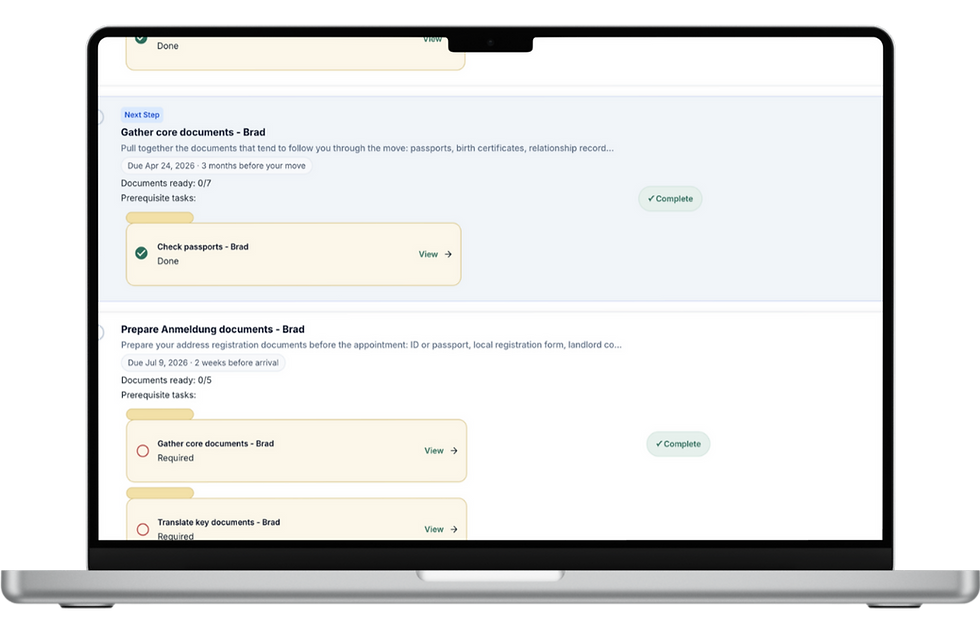
Where EuroHaven fits inThe first 30 days in Germany are manageable, but they are not random. They are connected. EuroHaven is built around those connections. It helps turn relocation information into a personalized plan based on your destination, household, documents, timing, housing needs, pets, car, employment, and family situation. Instead of asking “what do I do next?” every morning, EuroHaven helps you see what applies, what depends on what, what documents may be needed, and what is already done. This guide explains the process. EuroHaven turns it into a plan based on your actual move. |
Final thoughts
Your first 30 days in Germany do not have to be perfect. They do need to be organized.
Germany rewards preparation. It also rewards people who keep documents, read letters, confirm requirements, and do not assume that one person’s relocation story applies to everyone else.
The good news is that once the first wave of admin settles, life starts to feel much less like a paperwork obstacle course. The grocery store becomes familiar. The train system starts to make sense. The official letters become less terrifying. You learn which forms matter and which ones just look important because every German document is designed with the emotional warmth of a tax audit.
Use official sources to confirm the rules. Use qualified professionals where needed. Compare providers carefully. And if you want a clearer way to track the tasks, documents, and dependencies of your actual move, EuroHaven is built for exactly that.


Comments